
Can I Trust You? A Conversation with Robert Thomi
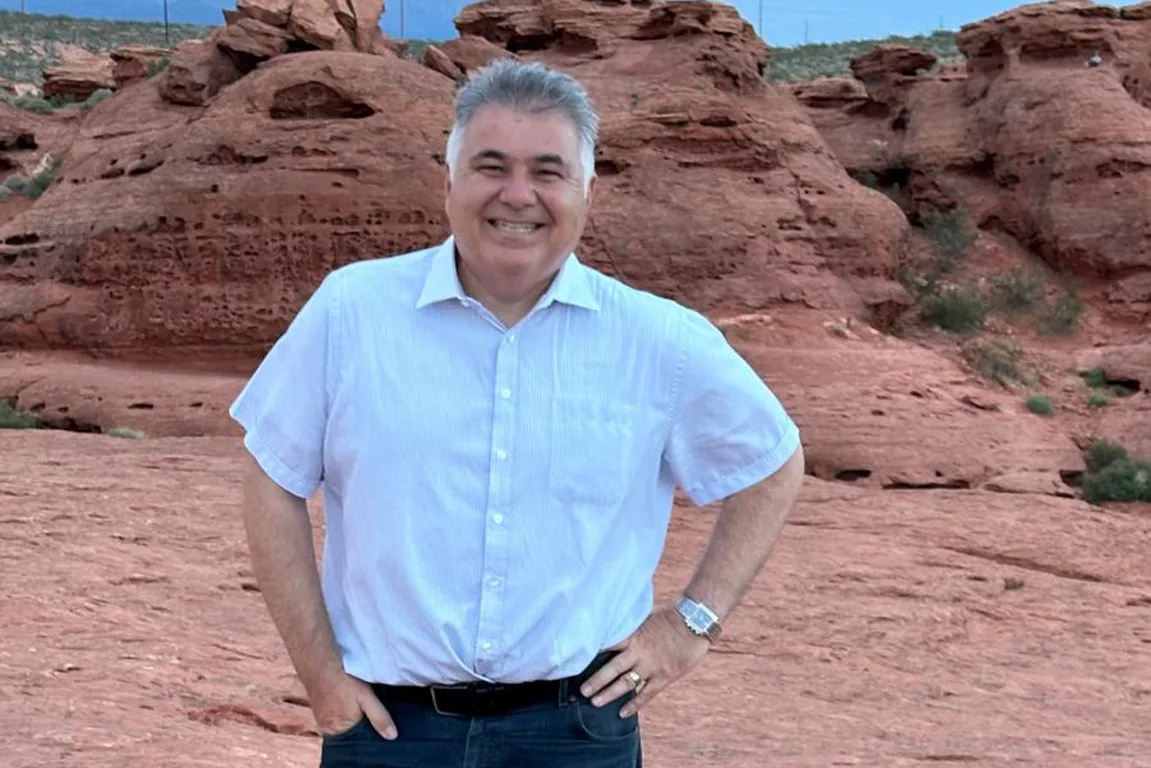
Almost eight years ago, an email arrived from a Swiss goldsmith we had never met. More emails followed. Then a call. And on that call, before any work, any contract, any demo, Robert Thomi asked his question: "Can I trust you?"
There is no good answer to a question like that. There is only the time that comes after it. Eight years of it now, in which Robert went from a stranger in the inbox to a collaborator, and then to something simpler and rarer: a very good friend.
So when we recorded the first episode of the iJewel Podcast in September 2025, we asked him to tell the story behind the question. This is what he told us. Quotes are lightly edited for clarity.
It started with opals
Robert grew up partly around opals. His father loved them, started making jewelry with them, and sold the pieces while Robert watched as a boy.
The pull was there even earlier. "When I was a little kid, just give me some paper and a pencil, and I was quiet for two hours."
Getting into the trade was harder than loving it. A goldsmith's apprenticeship in Switzerland was not easy to land. Robert went from company to company until he was accepted for a four-year apprenticeship, in an atelier that did work for the Kingdom of Oman. The assignments were not ordinary. "We made the car keys out of gold for the limousines of the King of Oman. And diadems. We always had several millions in the atelier: diamonds, emeralds, precious gold."
The light on the ceiling
We asked Robert if there was a moment when the craft became his home. He did not talk about a commission or a career milestone. He talked about light.
"The moment you have gold and diamonds on your bench and in your hand, and the sunlight hits your working place, and all the dispersion colors from the gems light up the ceiling above the bench. There is nothing similar to that."
"When you polish the jewel, when from nothing, just from pieces of gold, you make a finished jewel. That's nothing less than magic."
Ask him where designs come from and the answer is just as direct: from people. "You just imagine who you want to make this jewelry for. Sometimes people come with just some gemstones, some gold. You look at the person, and the person inspires you." When no idea comes, he walks along the lake, looks at the mountains, and waits. "Nature is a really big inspirational source for me."
Problems are just a job to do
Robert's account of the hard parts of his career is short, because he refuses to frame them as hard.
His filter is the same trust question he once asked us. "I definitely choose my friends, and I choose the activities I do. When I see something and I don't have a good feeling, I don't do it. My motivations are never money-based. That way I avoid a lot of trouble." The one thing he names as genuinely difficult is watching original designs get copied. Even there, he shrugs: "This is the jewelry industry. Everybody can copy. But to do something really good in advance, that is actually the art."
"I do not think that problems are problems. Problems mostly are just a job to do. What are the facts? What is the solution? Then go forward, never go back."
Photographing a mirror
Robert's road into software began with a practical problem every jeweler knows: showing the work.
Selling jewelry means brochures, posters, product pictures. In the analog days that meant a photographer, and jewelry is close to the worst subject a camera can face. "Jewelry photography is like photographing a mirror. It's polished, it reflects everything. Even my face as the cameraman, I see my face and the camera in the jewelry." Then came retouching: masking in Photoshop, removing dust, repeating the whole session for a different metal color. Hours, sometimes days, per shoot. His verdict: "a pain in the neck, to be honest."
3D offered a way out. Robert bought a license for 3ds Max, a general-purpose 3D modeling tool, and later added V-Ray, a renderer, for better images. The move came with a twist of geography: Robert had relocated to Bulgaria, and Sofia happens to be the home city of Chaos, the company behind V-Ray. That was about twenty years ago. "So I didn't start just yesterday. It's a long journey."
The learning was not smooth. He took a course at almost forty, taught by a school student. "That was a little bit funny, the age difference. But young people grow up with the technology, and I benefited." The tools rewarded patience and punished it in equal measure. He gave himself a month per problem and kept going.
"Sometimes I was thinking the whole day, why does this not work? And it was just one little button. These tools are extremely good, but extremely complex."
Why it was worth it, he explains as a goldsmith would. To photograph a real ring you must first buy the gold, set the stones, polish the piece, shoot it, and if the client wants white gold instead of yellow, start the masking again. "It is so much easier in 3D. So much easier."
Sketches his wife couldn't read
Robert's view of where the industry is going starts with a story against himself.
When he made the wedding rings for himself and his wife, he drew sketches to show her. "She said, I don't understand how this is. I don't get it. I tried a little better with colors, and she still didn't get it." The person the ring was for, the only audience that mattered, could not see it until it existed.
That gap is what he thinks the current generation of tools is closing. Configurators let a client change a design and see the change at once. Interactive 3D lets them turn the piece themselves. Try-on lets them ask the last question a photo can never answer: how does it look on my hand? In his words, "a perfect opportunity for somebody to decide faster and better: do I like it, or do I not like it?"
Where does it go from here? "Toward convenience for the client, so that the client can choose: I want to have the jewelry the way I want." He would like to see the watch industry follow. "You have this variation or that one, but not a lot of individual changes people can make. I hope this will change. Individual, for people."
Robert has worked with iJewel3D for years, and he is a friend, so when he praises the tools, take it as a friend's view, not a neutral review. What he singles out, though, is not a feature.
"When the clients have a need, and we can see that life will get easier for the user, we listen. What are the needs? What will be very good for people to have? I love that."
The answer to the question
Robert's advice to young designers is the same advice he gives himself. Get inspired by nature. Study proportion in a flower or a mountain. And remember the wearer: soften the edges, bevel what could scratch, make something a person wants to put on and forget.
You can see what that advice looks like when it becomes metal and stone. Ask Robert about "It's always Spring!", the ring below, and he goes straight back to nature. "I like spring as a season. Everything is blooming, everything is growing, everything is waking back up after winter. It brings a lot of new energy and a lot of ideas."
The season is only half of the idea. The other half is practical, as it always is with Robert. He built the ring as a playground: a single design where other designers can swap between iJewel3D's material presets, the enamel, the pearl, the gems, and see how a gemstone with an unusual shape renders in real time. "I wanted to combine the practical use of iJewel with some newborn feelings."
Underneath all of it sits the question from that first call. Can I trust you? He asks it of collaborators, of tools, of his own designs. The atelier in Switzerland, the opals, the gold car keys, the month-long fights with a checkbox in a render setting, they are all the same discipline.
Choose carefully, then commit fully.
Eight years ago the question had no answer. Now it has one, and it is not written in any contract. It looks like two people on a call, still smiling, still working, still friends.
This was the first episode of the iJewel Podcast. There will be more conversations with the designers and businesses who make this industry what it is.
Our thanks to Robert Thomi for his time, and for a friendship that keeps answering its own first question. You can check out Robert's work on iJewel Design.