
Why Wedding Band Builder
The Problem
Most online jewelry stores present wedding bands as static image catalogs with a fixed set of pre made options. This creates several issues for jewellers:
- Lost sales: customers can't visualize exactly what they want, so they hesitate or leave
- Returns and remakes: what looked good in a photo doesn't match expectations
- Limited catalog: every new option requires new photography, new 3D models, new SKUs
- No at-home experience: customers still need to visit a store to see the ring in context
The Solution
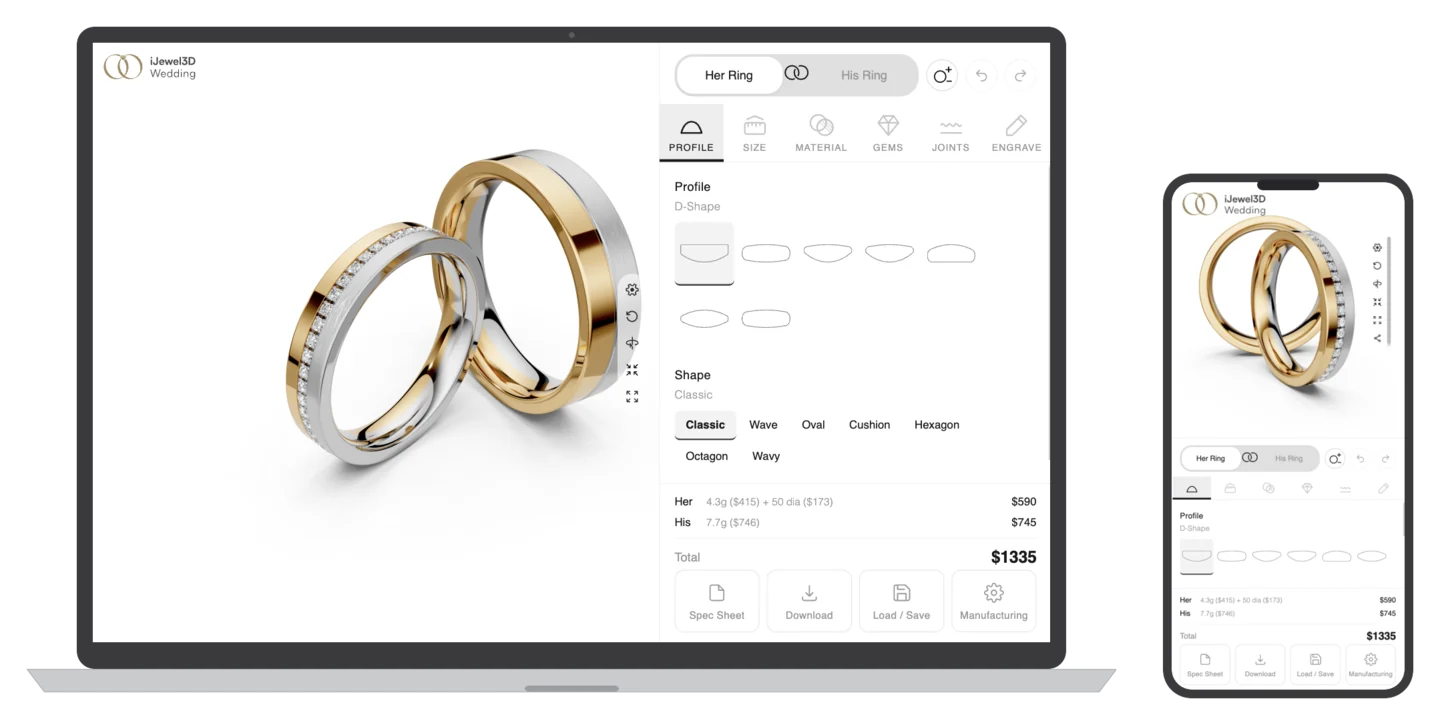
The Wedding Band Builder replaces static catalogs with a real time design engine. Customers design their ring by adjusting dimensions, materials, and details that update live in 3D. The rendered preview reflects physically based materials and lighting.
Competitive Advantages
Runs in the Browser, No App Needed
The configurator runs entirely in the browser on desktop, tablet, and phone. No app install or plugin is required. Reducing friction between browsing and purchasing tends to improve conversion rates.
AR Try On
Customers can preview their designed ring on their hand using camera-based live hand tracking. This gives a sense of scale and appearance before purchasing.
Spec Sheets for Manufacturing
Every design produces a precise specification sheet: profile cross section diagram, dimensions in millimeters, ring size across three international systems, metal composition, diamond count and carat weight, and complete pricing breakdown. Your CAD team or CNC machine gets exactly what was designed on screen.
His & Her Paired Band Configuration
Customers design both bands together. Linked mode keeps both rings in sync: change the metal on one, both update. Independent mode lets each band be unique. The pricing shows individual and combined totals.
Global Pricing
Not every jeweller prices the same way. The engine supports:
- Western model: markup multiplier (1.5×–2.5×) covering all costs
- Indian model: explicit making charges (8–35% of metal cost)
- Gulf model: per-gram making charges ($5–$50/gram)
Per-metal pricing (white gold costs more than yellow due to palladium), finish surcharges, diamond setting labor costs, and configurable rounding are all built in.
Physically Based Rendering
The 3D engine uses PBR materials with image-based lighting and real time gem refraction. White gold has the reflectance of a palladium alloy. A hammered finish displaces the surface geometry. Diamonds refract light through computed facets. This isn't a texture swap on a generic 3D model.
No Vendor Lock In
Your configuration data is JSON. Export it, store it, migrate it. The headless API means your frontend is yours: your team or agency builds and maintains the UI without depending on a third party for every change. Switch hosting, switch CMS, switch developer. The data and the integration stay portable.
Works With Any Manufacturer
The spec sheet is manufacturer-independent. It outputs profile cross sections, exact dimensions in millimeters, ring size across three international systems, metal composition, and diamond specs. Send it to any workshop, any CAD team, any CNC machine.
Your Brand, Your Design
Use the built-in UI with one of 11 theme presets, or build your own interface from scratch using the headless SDK. The configurator is a white label engine. Your customers see your brand, not ours. No billable hours to a vendor for branding changes or layout updates.
Mobile Optimized
The 3D engine is optimized for mobile GPUs. Touch gestures such as pinch to zoom and swipe to rotate work natively. On compatible devices, camera Try-On lets customers preview the ring on their hand in current Safari on iOS and Chrome on Android.
Predictable Costs
One-time onboarding plus an annual subscription. No opaque project pricing, no change orders for every UI tweak. You know what you'll pay.
Dedicated Onboarding
Setup assistance is included. Documentation, email support, and a partner network for integrations. You're not left to figure it out from a wiki.
Ecommerce Ready
Drop in integrations for the platforms your business already uses:
| Platform | Integration |
|---|---|
| Shopify | Liquid section, iframe embed, add-to-cart bridge |
| WooCommerce | Shortcode or custom product template |
| Magento | Custom block with Storefront API |
| BigCommerce | Stencil theme template |
| Wix | HTML embed with Velo integration |
Or integrate directly with any website using a <script> tag or iframe.
Use Cases
The Luxury Brand
A high end jeweller wants the configurator to feel like an extension of their brand. They use the headless SDK to build a completely custom interface: their fonts, their layout, their animation. The 3D engine runs underneath, invisible to the customer. The spec sheet includes their logo and branding.
The Shopify Store
An online jewelry retailer wants to add wedding band customization without rebuilding their site. They embed the configurator as an iframe in a Shopify product page. Customers configure their ring, see the price, and click "Add to Cart." The configuration data flows into the Shopify cart as line item properties.
The Indian Jeweller
A jeweller in Mumbai needs making charges calculated as a percentage of metal cost, per-metal pricing for different gold alloys, and the ability to show customers a detailed cost breakdown. They configure the Indian pricing model and the pricing engine handles the math: metal cost, 18% making charge, diamond cost, setting labor, all itemized.
The Manufacturer
A ring manufacturer wants their retail partners to use the configurator as a sales tool. Customers design their ring in the showroom or at home. The jeweller downloads the spec sheet and sends it to manufacturing. The dimensions are exact, calculated from the actual 3D geometry, not approximations.