
Twenty Rings a Day: A Conversation with iGold3D
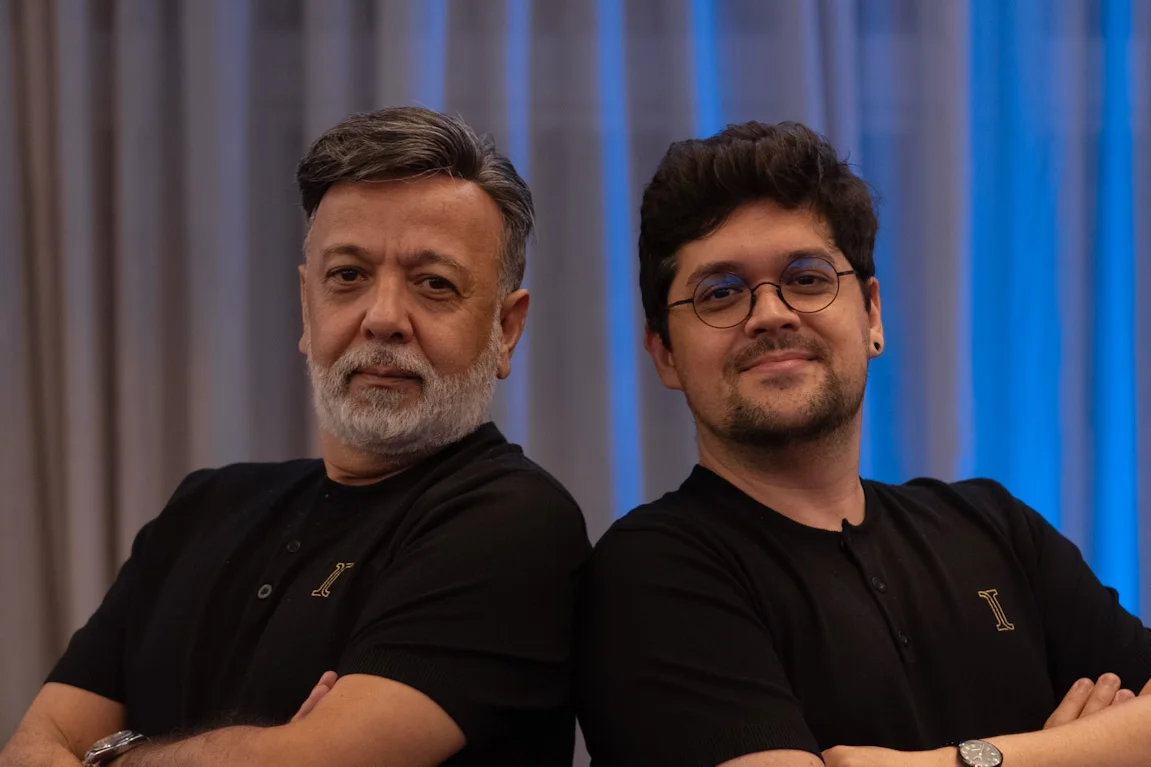
In September 2025 we sat down on a video call with Igor M. Penharbel and Oldemar Alves, the two designers behind iGold3D, a 3D jewelry design studio in Brazil. They model custom jewelry for goldsmiths, piece by piece, on order. On a normal day, about twenty pieces leave their screens. The queue behind them never empties.
We wanted to hear how they got here, what the work actually looks like, and what they need from the tools they use. Igor spoke for both of them. Oldemar speaks Portuguese, so Igor translated as we went, with a cat named Zelda walking through the frame from time to time.
This is their story, told mostly in their own words. Quotes are lightly edited for clarity.
A law degree and a bass guitar
Igor did not plan to design jewelry. As a teenager he played bass in a band, loved Zelda and Star Wars, and wanted to make video games with his friends. He was looking for a career with no math in it.
His father, who worked in law, gave him the advice fathers give. "He said, make it. Even if you never work in it, it is for your life." So Igor studied law. There is no math in law, he points out.
Two or three years in, his father passed away. The field stopped making sense to him. He took a job at a software business run by a friend of his father, and on a routine client visit a stranger asked him a question that changed his direction: you like technology, do you want to earn money drawing 3D jewelry?
He was about twenty. He tried it. "And man, I loved it."
He worked with that client for six years. When the arrangement ended, he stood at a fork: go back to law, or keep drawing jewelry, alone, at home, finding clients on the internet. He kept drawing.
The man of gold
Oldemar's path was the opposite. He did not find jewelry. He was born into it.
His family has been in the jewelry business in Brazil for fifty years. He started working in it at twelve, because he wanted to earn his own money. Later he left to study engineering, and stayed away about six years.
Engineering did not hold him. "He didn't like it. He wasn't happy," Igor translated. "He loves jewelry. All his family works with jewelry. We say here that he is the man of gold."
The turn came during the pandemic. Stuck at home, Oldemar started learning to make jewelry in 3D. What began as something to do became, in Igor's words, a new love for the craft he had grown up inside.
A classroom, then a company
The two met the way many working designers now meet: in the group chat of an online course.
Igor had hit a wall. At his old job the work was mostly pendants and earrings for fashion jewelry. Out on his own, the market wanted something else. "About 98% of the industry is rings," he told us, speaking from his own client work.
"And I didn't know how to draw rings. Six years drawing, and I didn't know how to draw rings."
So he bought a Brazilian course on 3D jewelry to fill the gap. Oldemar was in the same class. They started trading questions, then help, then work. Today they run iGold3D together, and Igor draws rings all day, with four, five, six modeling windows open at once.
Both of them work in Rhinoceros, a CAD tool widely used for jewelry. Igor started with the books of a Brazilian teacher who runs a school around it, and taught himself the rest by clicking and trying. He has also worked in ZBrush, a free-form sculpting tool. Different tools, different jobs. The modeling was never the hard part.
The hard part was showing the client
iGold3D's customers are goldsmiths who sell custom jewelry. Behind every goldsmith is a final customer, a person who has an idea of a ring in their head and wants to see it before it is made.
For a long time, the handoff was a screenshot. A capture of the CAD viewport, dimensions and interface and all, sent over WhatsApp. "It's really difficult to convey the idea with a print screen," Igor said.
For rendered images they used KeyShot, and later tried Light Tracer, both rendering tools that turn a model into a realistic picture. The pictures were good. But a picture is fixed. The client sees one angle, one metal, one moment.
What changed their daily work was real-time 3D with a shareable link. Igor described the first time he saw it:
"The client can turn the piece on his phone, on a computer, on a tablet. Change the material color. See it in real time. I said, Oldemar, look at this, man."
You can do what Oldemar did. This is iGold3D's first-place design from the iJewel3D Contest 2025:
His opinion of it is not shy. "The difference, in my opinion, is that you can share the link, and the person can turn the model themselves. There's no way to work without it today." That is his experience, from a studio that ships twenty approvals a day. A static render and an interactive link answer different needs, and for their approval-heavy workflow, the link won.
The temporary link
One detail from the conversation stayed with us, because it says something about how tools should be built.
Most of iGold3D's work is approval work. A goldsmith's customer just needs to look at a simple ring and say yes. The model does not need to live anywhere afterward. So iGold3D leaned on temporary links: share, get the yes, let it expire. Some customers insist on it. An exclusive design should not sit on the public internet.
"He said, I don't want my model showing to the world. It's mine."
At one point we removed the temporary link feature from iJewel3D. For us it was a small change. For iGold3D it broke the daily rhythm: now every approval meant saving a project, sharing it, then going back to delete it to free up space. Twenty times a day.
Igor wrote to us and explained the Brazilian custom jewelry workflow, patiently, to a team on the other side of the world. The feature came back.
We tell this story on ourselves for a reason. The lesson is not that we fixed it. The lesson is that we could not have known without being told. A feature that looks redundant from inside a product can be load-bearing in a workflow the builders have never seen. The only way to find out is to stay close to the people doing the work, in the Discord, in the emails, in calls like this one.
Where they think it is going
Igor and Oldemar sit inside large Telegram and WhatsApp groups of Brazilian 3D jewelry designers. Oldemar runs one with about four hundred designers and goldsmiths in it. From that seat, they see more people arriving at 3D every year, and they see the tools they like spreading the way theirs did: someone posts a link and says, look at this.
Their portfolio now lives online as interactive models rather than image galleries, and they use it to win work: look what we can do, come draw with us.
The distance between the idea and the yes
Strip away the software names and the story is old. A person imagines a piece of jewelry. Someone with skill has to show it to them before it exists, well enough that they can say yes with confidence.
For fifty years Oldemar's family did that with metal and wax. Igor learned to do it with a screenshot, then a rendered picture, then a link that turns in a customer's hand. The need never changed. Only the distance between the idea and the yes, and that distance keeps getting shorter.
Twenty times a day, in Brazil, it gets shorter still.
Our thanks to Igor and Oldemar for their time. You can check out iGold3D's work on iJewel Design and Instagram.